


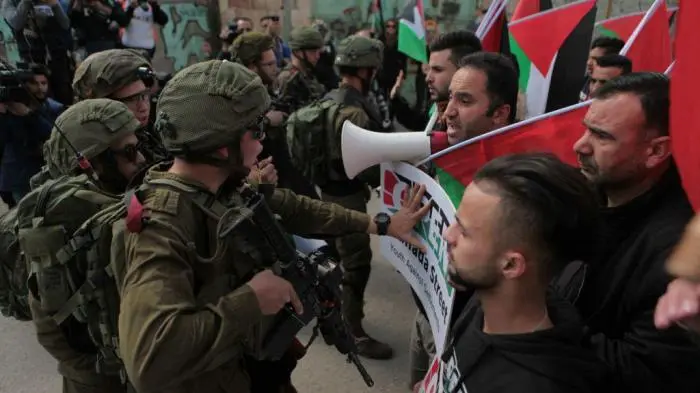
In recent months, the world has been gripped by images of mass protests and heightened tensions linked to the ongoing humanitarian crisis in Gaza. Demonstrations across various cities have drawn thousands of participants demanding international action, ceasefire measures, and accountability for civilian suffering.
- Understanding the Gaza Protests
- The Security Firm’s Position
- Activists’ Perspective
- Legal and Political Dimensions
- The Role of Media Coverage
- Ethical Concerns and Human Rights
- Global Repercussions
- Expert Opinions
- What Lies Ahead
- FAQs
- Why are Gaza protest evictions controversial?
- What does “last resort” mean in this context?
- Are Gaza protest evictions legal?
- How do evictions affect protest movements?
- What role does media play in Gaza protest evictions?
- Conclusion
However, these large-scale protests have also given rise to intense clashes between demonstrators, local authorities, and private security firms tasked with maintaining order. At the center of the controversy is a string of evictions that security companies describe as a “last resort,” sparking debate over civil rights, public safety, and the limits of protest in democratic societies.
The claim that Gaza protest evictions were not pre-planned but a response to escalating situations has fueled passionate discussions, as activists argue that removing demonstrators undermines their constitutional rights to free speech and peaceful assembly. This article explores the multilayered dimensions of Gaza protest evictions, analyzing the role of security firms, the perspective of protesters, the political backdrop, and the ethical questions driving global debate.
Understanding the Gaza Protests
The protests related to Gaza are not isolated events but part of a larger international outcry over the humanitarian disaster in the region. Tens of thousands of civilians have faced displacement, food insecurity, and a collapsing healthcare system, leading to widespread solidarity movements worldwide. From university campuses to city squares, demonstrators have erected encampments, blocked roads, and organized sit-ins as symbolic acts of resistance. In cities such as London, New York, and Paris, protesters demanded that governments cut military ties with Israel and increase humanitarian aid to Gaza.
While the protests are largely peaceful, some escalated into confrontations with law enforcement, particularly when demonstrators refused to vacate restricted areas or blocked access to public institutions. This is where private security firms entered the scene, often contracted by municipalities or universities to manage risks associated with prolonged demonstrations.
The Security Firm’s Position
The security companies involved in Gaza protest evictions maintain that forced removals were never their first choice. Spokespersons have described evictions as a “last resort” taken only after negotiations, dialogue, and warnings failed to achieve compliance. According to industry insiders, the objective is not to silence dissent but to prevent situations from spiraling into violence, damage to property, or threats to public safety.
Security experts highlight that encampments can become logistically unmanageable over time, especially when sanitation, medical needs, and counter-protests create additional risks. “We exhaust every avenue of dialogue before initiating evictions,” one security firm representative stated, stressing that officers undergo training to use minimal force. The industry argues that its involvement is reactive rather than proactive, suggesting that evictions are triggered by specific breaches of agreements between organizers and local authorities.
Activists’ Perspective
For activists, however, the narrative of eviction as a “last resort” rings hollow. Many accuse private security firms of acting as enforcers for institutions eager to suppress visible dissent. Protesters argue that their encampments and demonstrations are critical tools to raise awareness and maintain public pressure on policymakers. Forced evictions, in their view, strip the protests of their symbolic power and erode democratic rights.
Several student leaders from campus protests have shared accounts of late-night raids where tents were dismantled, belongings confiscated, and demonstrators escorted off university property. These actions, they argue, created an atmosphere of fear and intimidation rather than constructive dialogue. Critics also point out that the term “last resort” often masks premeditated strategies designed to limit the visibility of pro-Gaza activism.
Legal and Political Dimensions
The legality of Gaza protest evictions is a complex issue, varying significantly across jurisdictions. In democratic societies, the right to peaceful assembly is enshrined in law, but it is not absolute. Authorities can impose restrictions in the name of public order, safety, and the protection of others’ rights. This legal gray area provides security firms with a wide margin of discretion, often leading to accusations of overreach.
Political leaders have responded differently to the protests. Some governments emphasize the importance of protecting freedom of speech, while others prioritize security and institutional stability. The polarized reactions reflect deeper divisions over foreign policy regarding the Gaza conflict. Lawmakers sympathetic to the protesters argue that evictions undermine democratic values, while others insist that prolonged demonstrations disrupt daily life and threaten public safety.
The Role of Media Coverage
Media portrayal of Gaza protest evictions has been pivotal in shaping public opinion. Footage of confrontations between security personnel and demonstrators often goes viral, fueling outrage and solidarity campaigns online. Pro-Palestinian activists highlight these videos as evidence of systemic suppression, while critics argue that the footage fails to capture the risks faced by authorities on the ground.
Journalistic framing plays a major role in the debate. Outlets sympathetic to protesters emphasize human rights and freedom of expression, while others focus on law and order, portraying security firms as guardians of stability. This divergence not only influences public discourse but also shapes how institutions justify their decisions.
Ethical Concerns and Human Rights
Beyond legality lies the pressing question of ethics. Should institutions rely on private firms to manage civic unrest, especially in matters tied to humanitarian crises like Gaza? Critics argue that outsourcing such responsibilities blurs accountability, allowing governments and universities to evade scrutiny. When evictions are conducted by private entities rather than public law enforcement, oversight becomes murkier, raising concerns about transparency and abuse of power.
Human rights organizations have condemned aggressive eviction tactics, arguing that they disproportionately target marginalized groups and silence critical voices. They stress that civil disobedience is a cornerstone of democratic activism and should not be curtailed by corporate interests. The debate touches on broader questions about the balance between order and freedom in societies that claim to value both.
Global Repercussions
The controversy over Gaza protest evictions extends far beyond the immediate sites of confrontation. Internationally, the evictions feed into narratives of systemic suppression of pro-Palestinian voices. Countries in the Global South, where solidarity with Gaza is widespread, have criticized Western institutions for what they perceive as hypocrisy—championing democracy abroad while curtailing dissent at home.
At the same time, the evictions have energized protest movements, drawing larger crowds in subsequent demonstrations. Rather than quelling dissent, the use of forceful tactics often galvanizes activists, creating cycles of confrontation that attract further media attention. In this sense, evictions are both a tactical response and a catalyst for continued mobilization.
Expert Opinions
Experts remain divided on the legitimacy of Gaza protest evictions. Political scientists argue that sustained protest movements inevitably face pushback, particularly when they disrupt powerful interests. Sociologists, however, emphasize that eviction-heavy strategies risk delegitimizing institutions and fueling polarization.
Dr. Sarah Klein, a professor of political sociology, notes, “Calling evictions a ‘last resort’ is an attempt to frame them as reluctant actions. But in practice, they often reflect an institutional unwillingness to tolerate sustained dissent.” Meanwhile, security consultants counter that the risks of escalation justify firm responses when negotiations fail.
What Lies Ahead
As the Gaza conflict continues, protests are unlikely to subside. Institutions and security firms will continue to face the challenge of balancing rights with responsibilities. The future of Gaza protest evictions will depend on evolving political climates, legal frameworks, and public sentiment. For activists, the challenge will be to maintain momentum while avoiding escalation. For security firms, the test lies in proving that evictions are indeed a last resort rather than a convenient solution.
FAQs
Why are Gaza protest evictions controversial?
They are controversial because they raise questions about the balance between public safety and freedom of speech. Critics argue that evictions silence dissent and undermine democratic rights, while security firms claim they are necessary to maintain order.
What does “last resort” mean in this context?
Security firms use the term to suggest that evictions only occur after other options, such as dialogue and negotiation, have failed. Activists, however, dispute this framing and claim that evictions are often premeditated.
Are Gaza protest evictions legal?
The legality depends on local laws. Most democracies protect the right to protest but allow restrictions for safety and public order. This creates legal ambiguity that security firms and institutions often exploit.
How do evictions affect protest movements?
While intended to disperse demonstrations, evictions often galvanize activists and attract more public attention, sometimes strengthening the movement instead of weakening it.
What role does media play in Gaza protest evictions?
Media coverage shapes public perception, with different outlets framing the events either as suppression of rights or as necessary measures for security. Viral videos of confrontations amplify global debates.
Conclusion
The controversy over Gaza protest evictions reflects a broader struggle between authority and activism, order and freedom, security and democracy. Security firms claim that evictions are a last resort, a reluctant response to escalating risks, but activists insist they are deliberate strategies to suppress dissent.
This clash of perspectives reveals not only the fragility of democratic principles under stress but also the enduring power of protest movements to command attention and shape narratives. As long as the Gaza crisis continues, demonstrations will remain a visible and forceful reminder of global concern, and the debate over how institutions respond to them will define the boundaries of civic freedom in an era of rising unrest.